Commander for Advocates · For VA-Accredited Claims Agents & Attorneys
Case management software for professional VA claims work.
Built for an accredited practice — claims agents and attorneys — to work a whole docket: read the C-file, decode the denial, and draft nexus letters, statements, and VA forms grounded in published BVA and CAVC case law, to the evidentiary standard VA raters evaluate against.
What Commander for Advocates does
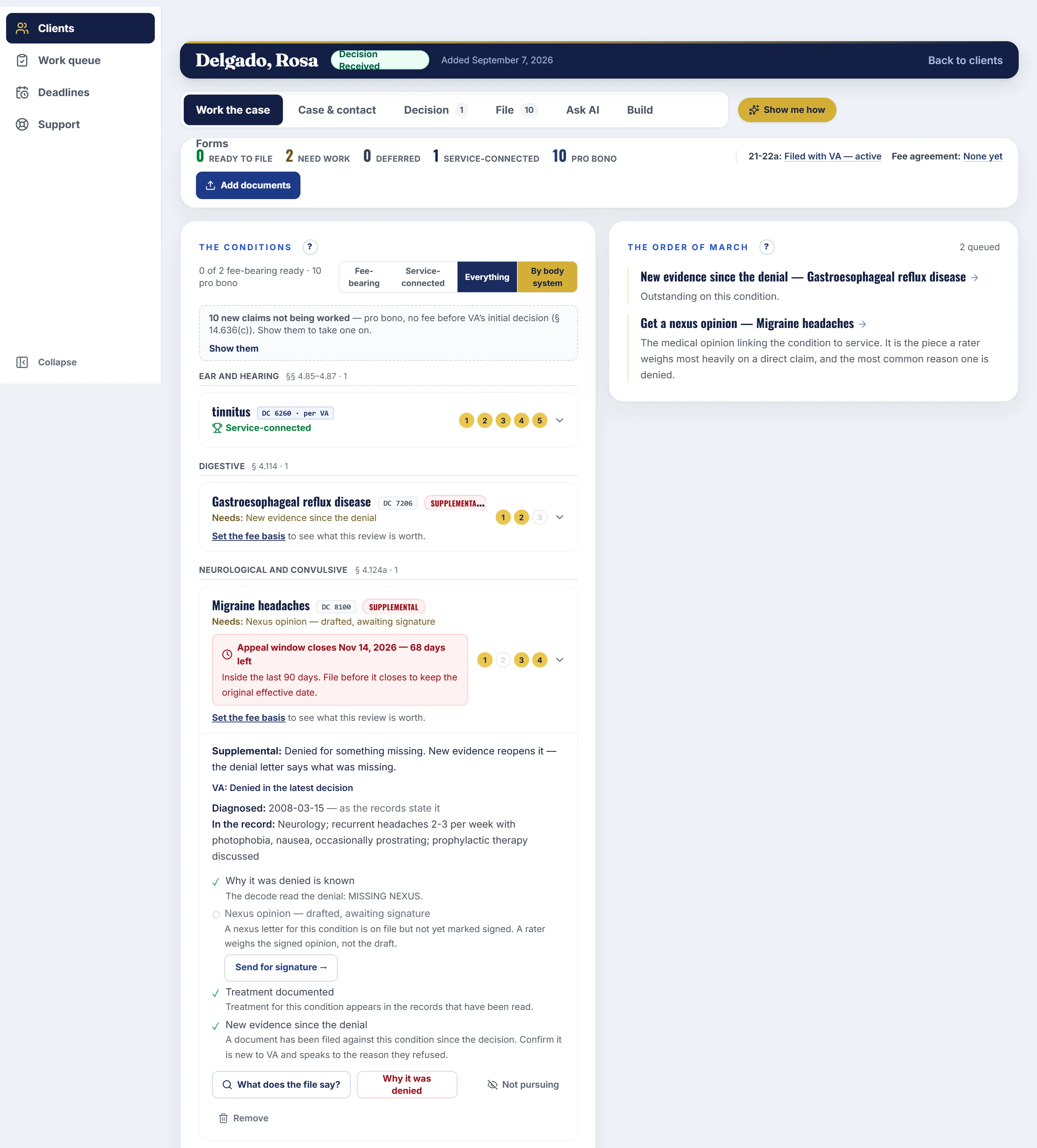
Decode the denial
Read a rating decision contention by contention: why each one lost in plain English, the gap VA named, and the review lane that wins it back — Supplemental, HLR, or Board.
Ask the file anything
Question the whole record — scanned pages included — and get answers cited to the exact document and page. One click puts an answer on a VA Form 21-4138 or into a letter on your letterhead.
Official forms, filled
The forms an accredited practice actually files — 21-0966 Intent to File, 21-22a, 21-4142 records authorization, 21-4138, and the lane forms 20-0995 / 20-0996 / 10182 — filled in-app with a live view of the real paper, denied issues prefilled from the decode.
Veteran & buddy statements
Request a personal statement from the veteran or a lay statement from a witness — they answer in plain words, the AI drafts it in their words, and they e-sign it themselves. Sworn testimony, never written for them.
The file cabinet, searchable
Drop a VBMS eFolder export and it lands categorized, dated, and in VA's own order — stored under our signed BAA, indexed page by page, analyzed for conditions and claim leads automatically.
Filing day, one PDF
Pick the enclosures and get a single QuickSubmit-ready packet — a letterhead cover sheet indexing every document, the evidence behind it in filing order. And when a denial flips to granted, the win is detected, celebrated, and the fee you realized is tracked.
See it
What the work looks like
More screens from the same test case. Every name and record here is synthetic.
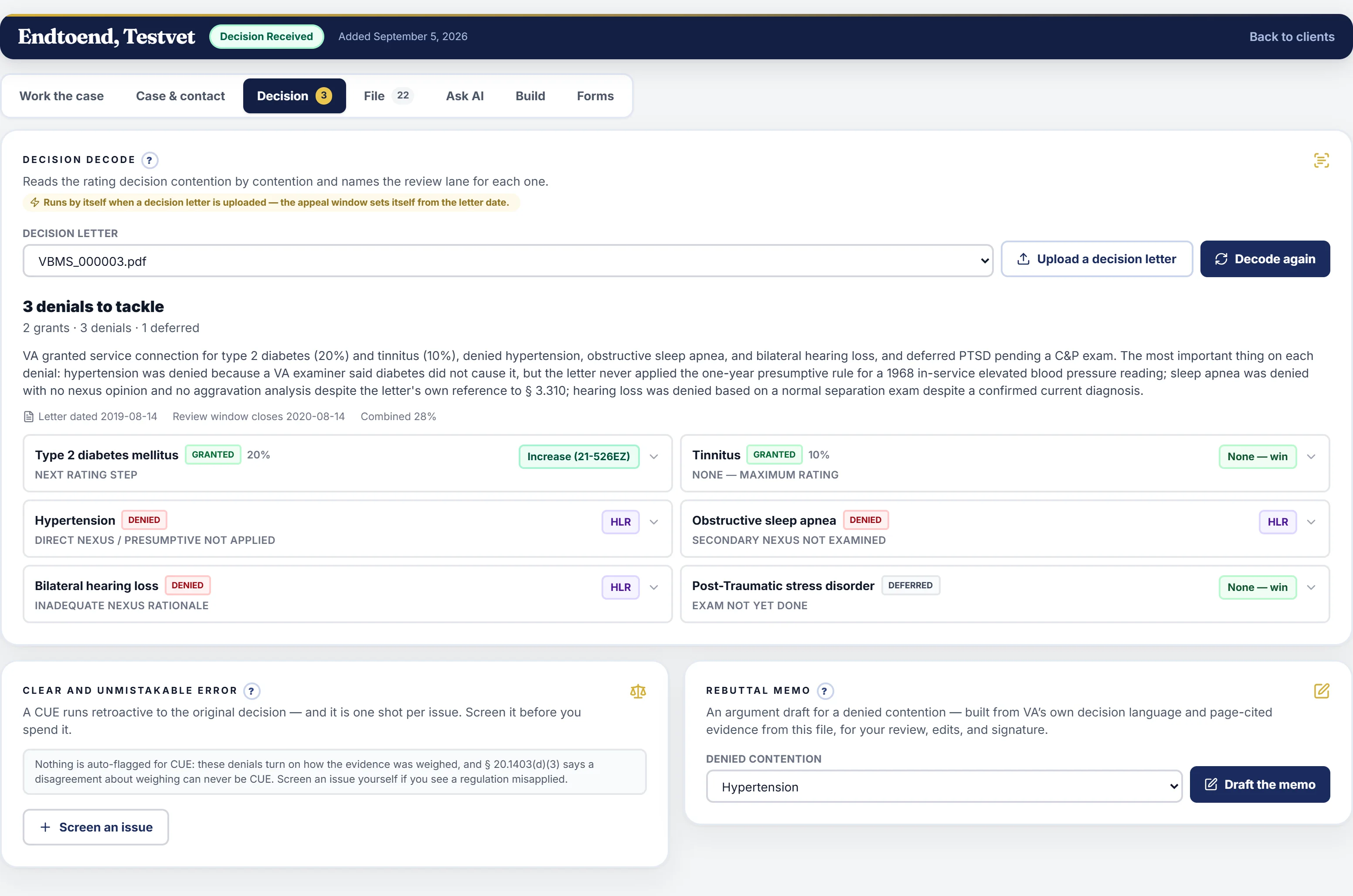
The rating decision read contention by contention: why each one lost, the favorable findings, and the lane that wins it back, the moment a letter is uploaded.
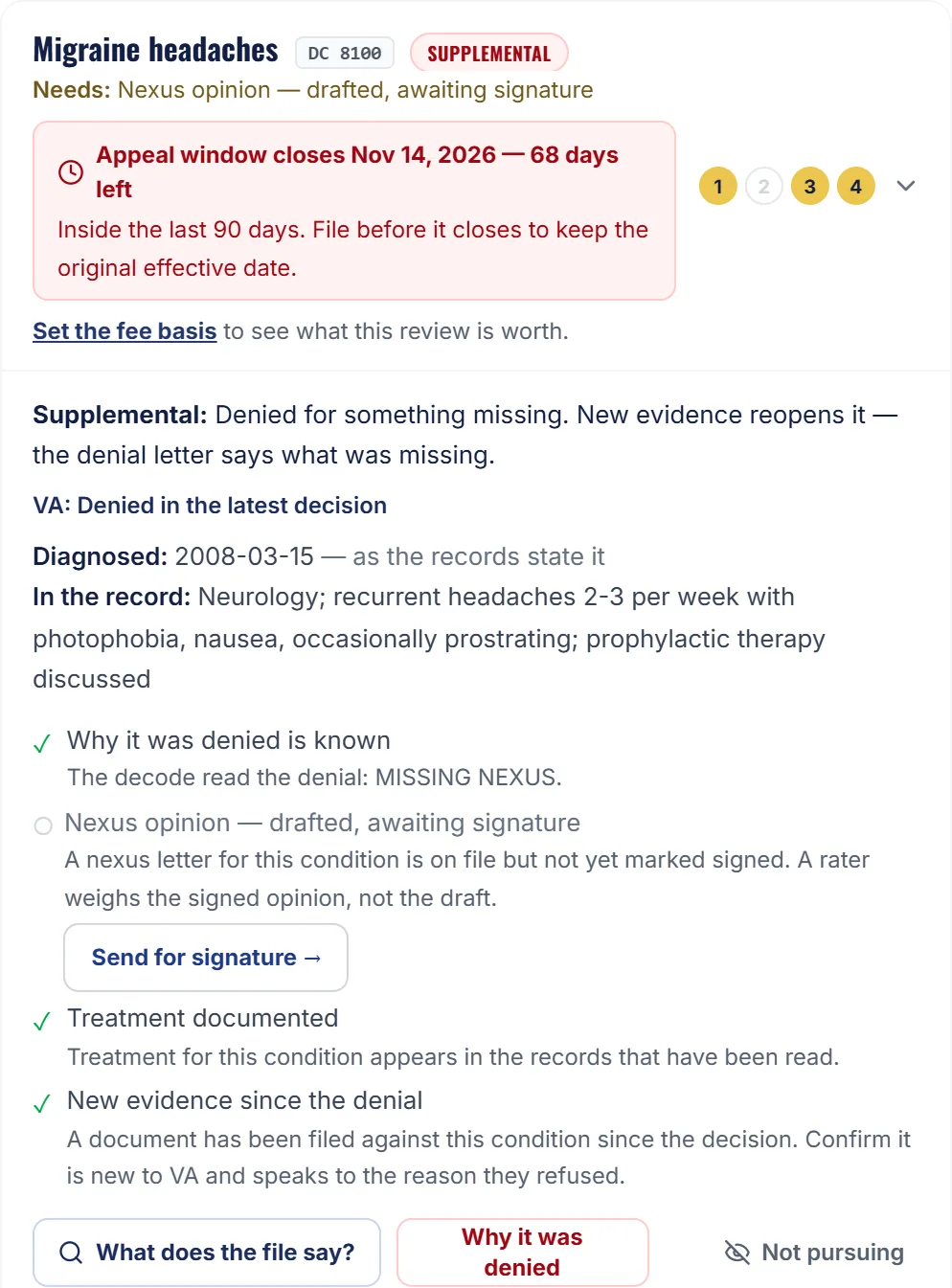
Open a card and the whole condition is there: why VA denied it, the diagnosis date as the records state it, what the file already shows, what is still missing, and the button that does the next thing.
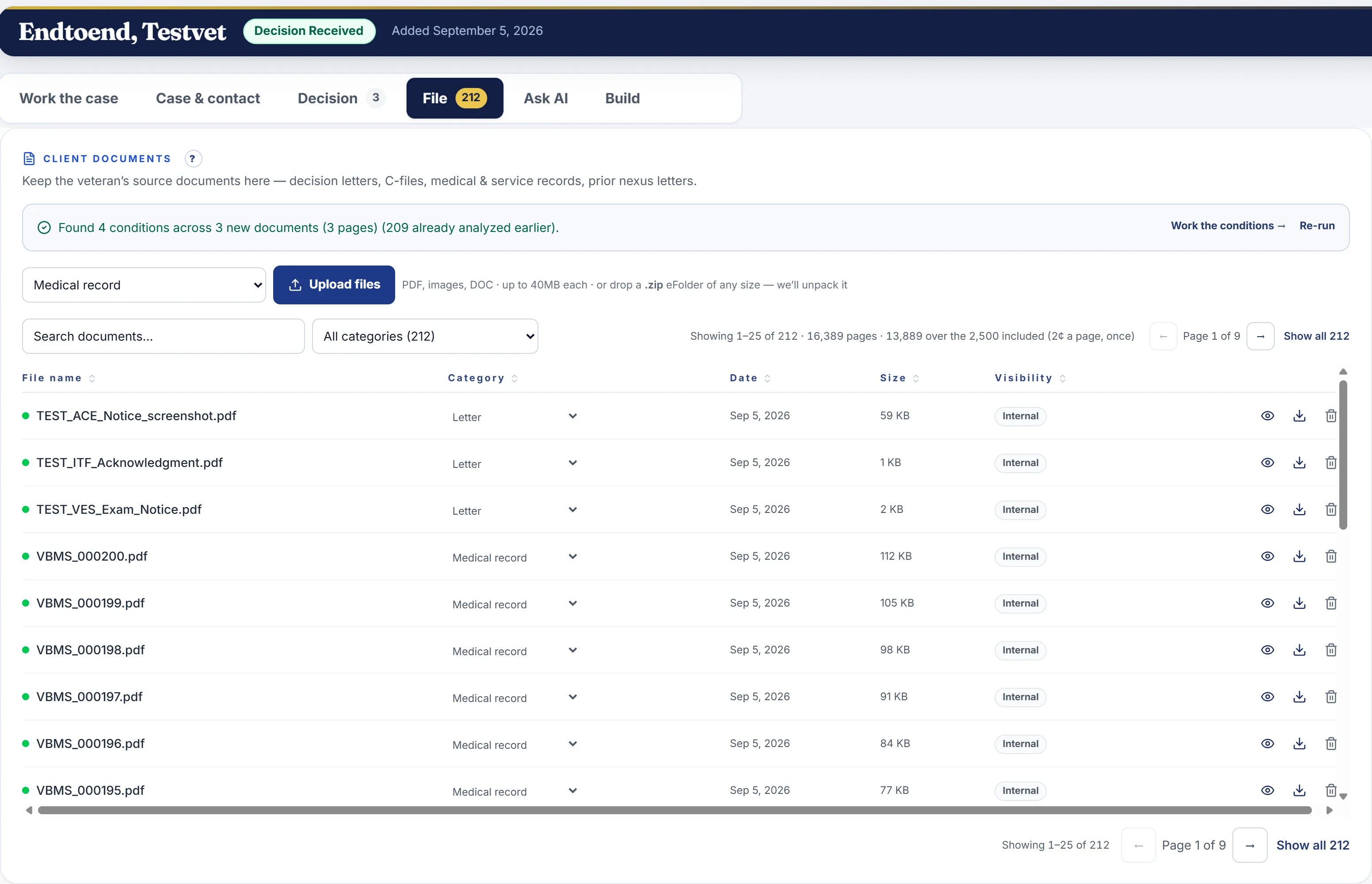
A 212-document eFolder unpacked and read end to end: 16,389 pages, every document typed by its content and searchable. Drop in a .zip of any size and it comes back sorted, with the conditions it found waiting on the case.
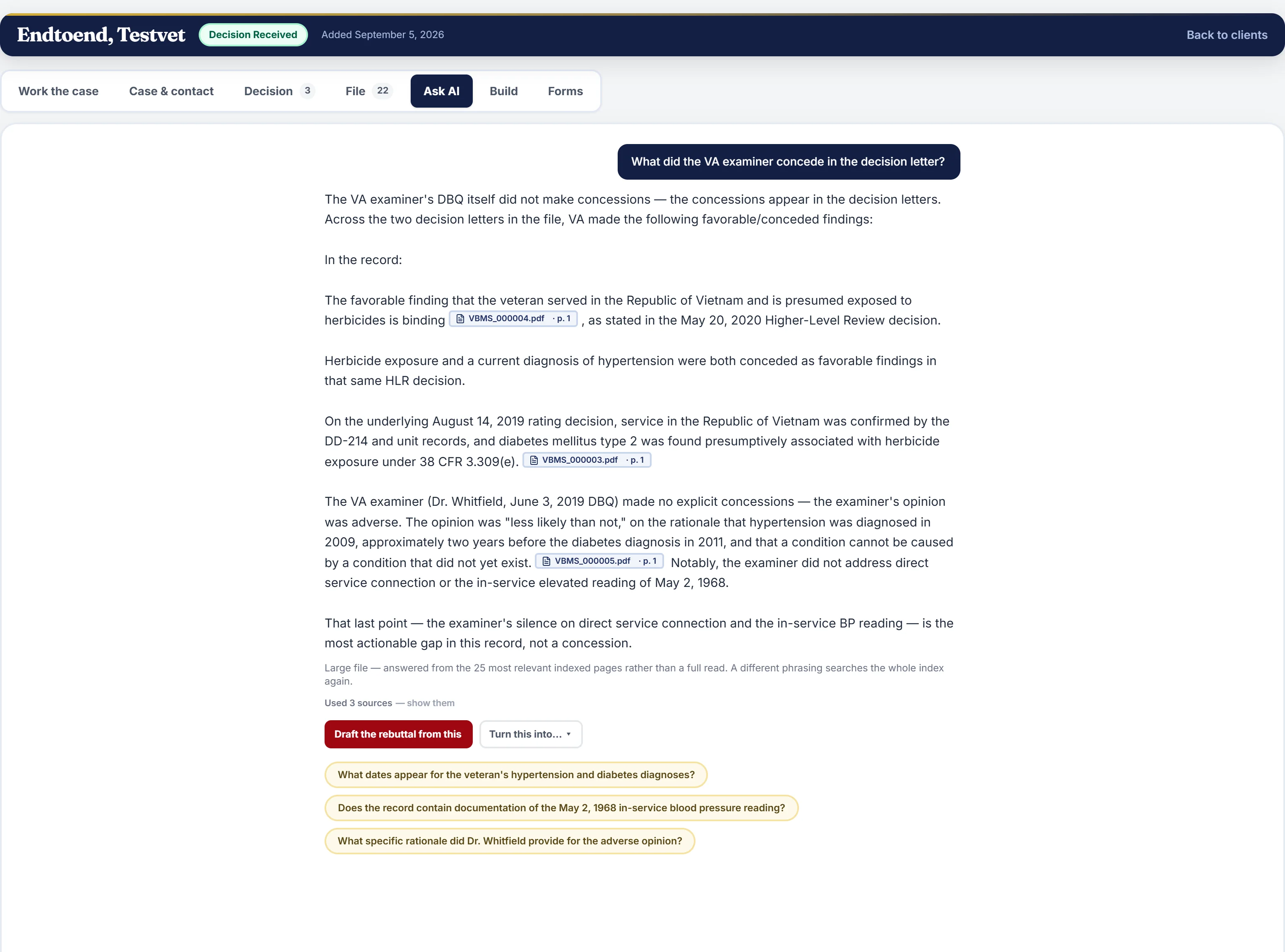
A question answered from the file, with the page it came from cited beside every fact.
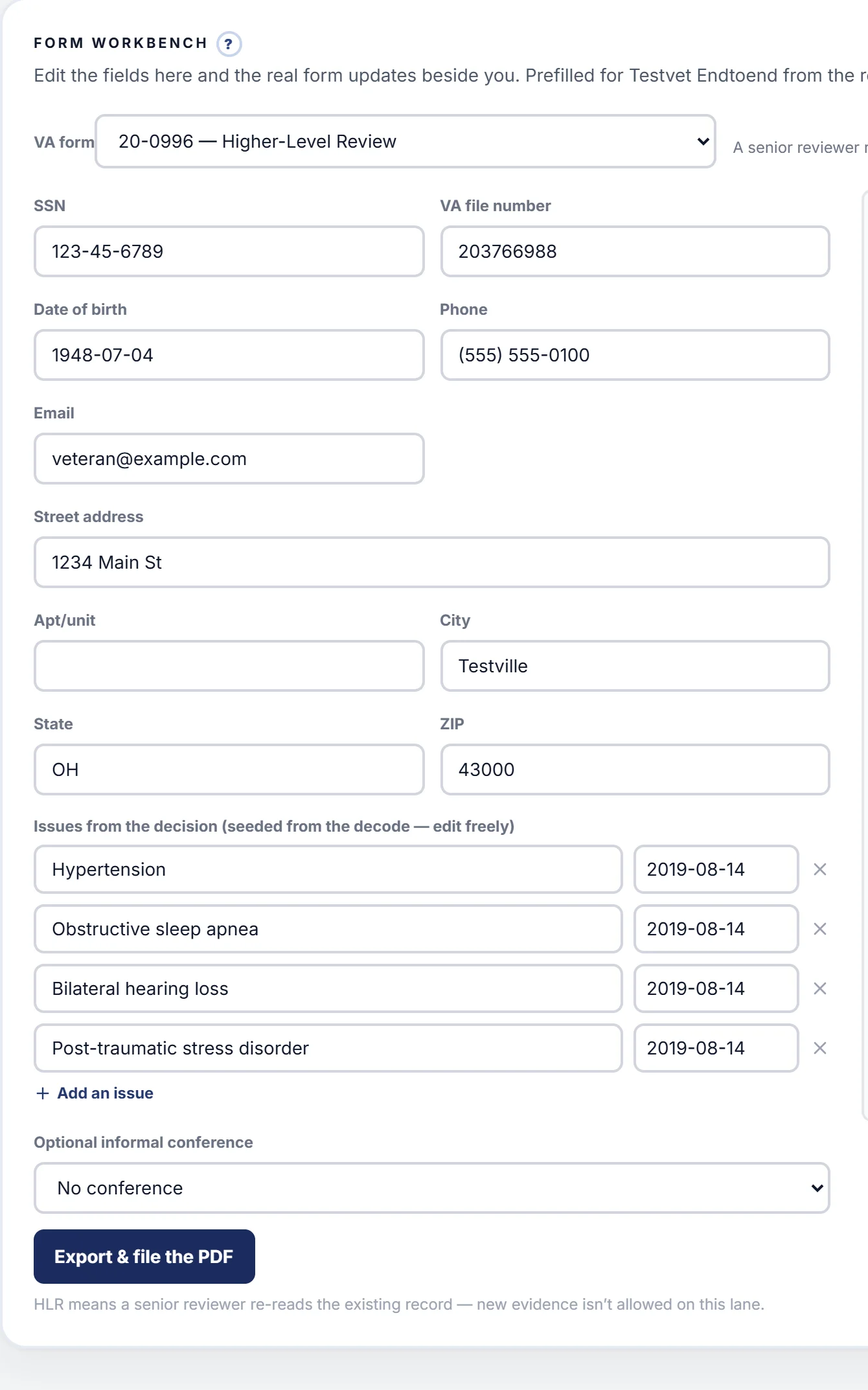
The 20-0996 with the denied issues seeded from the decode — the real form fills itself beside the fields and exports ready to file.
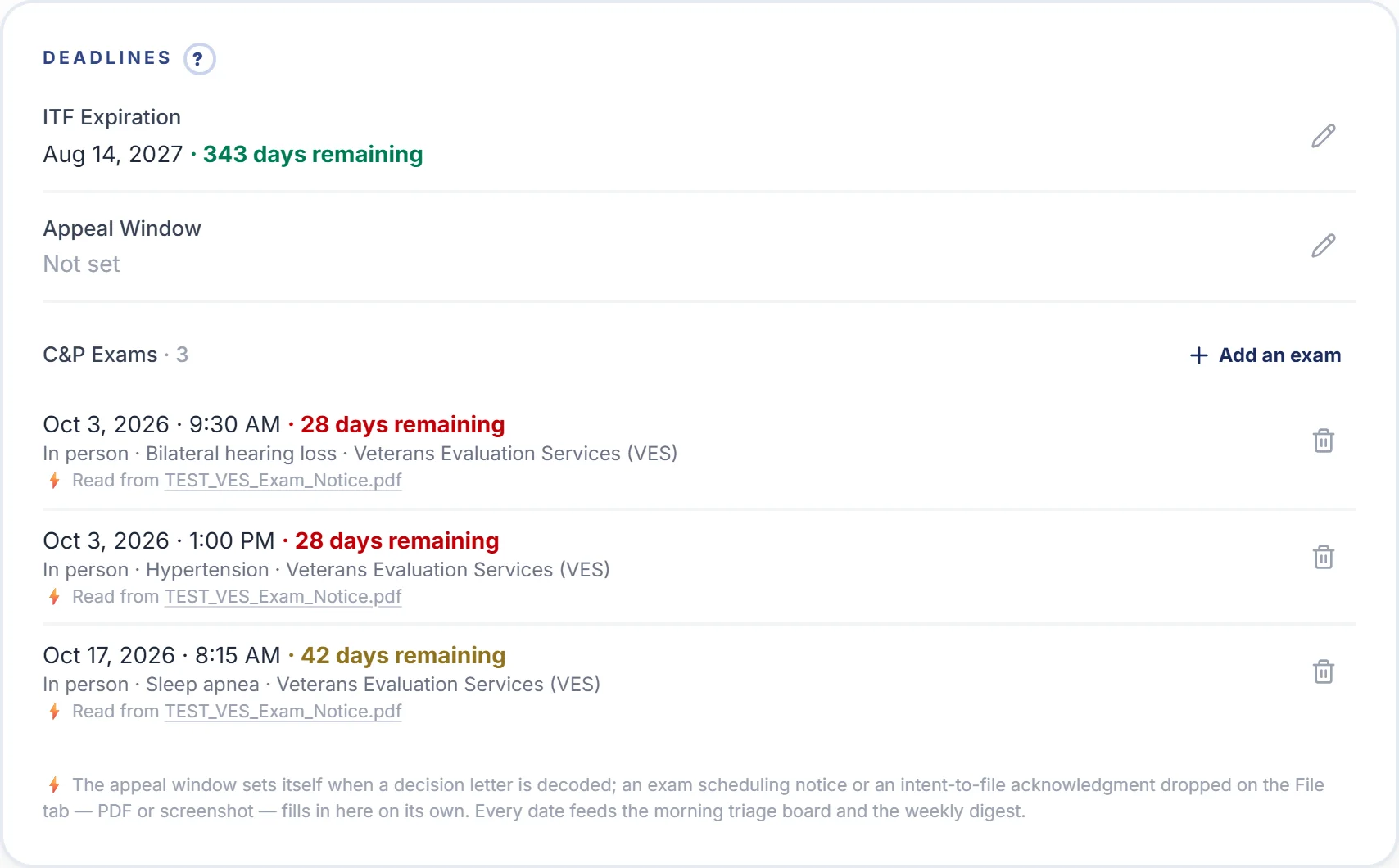
An exam notice or an intent-to-file acknowledgment dropped on the file lands on the calendar on its own.
Why advocates trust VA Claim Commander
Built to the rater's standard
Documents drafted to the evidentiary standard a VA Rating Veterans Service Representative evaluates against.
BVA & CAVC
Grounded in published BVA and CAVC federal appellate precedent.
5-day free trial
No credit card required to start.
Commander for Advocates plans
Pricing built for caseloads, not single claims.
Pay for the veterans you work, not the ones waiting on VA — $20 per veteran for each month you touch the case. Nothing while a case sits. See the estimator →
Per veteran worked
20 /veteran/month
$20 per veteran for each month you work them — an upload, a scan, a draft, a filing. A case that sits while VA decides costs nothing. Your first month is never more than $500, so a whole caseload can come over at once. For accredited claims agents and attorneys, one agent or twenty.
Pay only for who you serve
$20 per veteran — nothing for the ones you're not working.
With Commander for Advocates you pay $20 a month for each veteran you're actively serving — no seat licenses to buy up front, no minimums. Add a veteran when you take the case, drop them when it's filed. Your bill tracks your real caseload, month to month.
A clinical layer to escalate to
Nexus drafts here are provider-ready — a document isn't medical evidence until a licensed clinician reviews, edits, and signs it. Take a draft to the veteran's own provider, or refer to our partner Commander Health: a licensed NP reviews the records and signs the nexus ($500), completes the DBQ ($200), or both ($550 bundle) — when the evidence supports it. Nothing is guaranteed; the clinician can always say no.
Hours of paperwork, done in minutes
Documentation that eats hours of a service officer's day — statements, nexus drafts, evidence organization — comes back in minutes, so your office can focus on strategy while it handles the paperwork.
| What you get | Commander for Advocates |
|---|---|
| Veterans per plan | Every veteran you serve |
| Commander Scan (records analysis) | Included |
| NP-reviewed nexus & DBQ (Commander Health partner) | Nexus $500 · DBQ $200 · bundle $550 — signed when the records support it |
| Commander Check (opinion audit) | Free |
| Your data kept out of AI training | Always |
| Pricing | 20 per veteran for each month you work them — cases that sit are free |
Always verify a service's VA accreditation before paying for claims assistance — accredited VSO help is free.
For retroactive claims work
Find errors in old decisions.
The CUE detector reviews a client's prior decision letters for clear and unmistakable error — the kind that can reopen a final decision and recover a retroactive effective date. Surface the grounds worth challenging before you build the filing.
Start your free 5-day trial today.
No credit card required. Add your first client and generate a filing-ready document in minutes.
Straight answers
- Who is Commander for Advocates for?
- VA-accredited claims agents, accredited attorneys, and VSO representatives working more than one veteran at a time. One agent or twenty — staff logins are free, and you pay per veteran worked.
- How does the pricing work?
- 20 per veteran for each calendar month you work them — an upload, a scan, a draft, a filing. A case sitting at VA costs nothing and there is nothing to archive. Your first month is never more than 500, so a whole caseload can come over at once.
- Can it read a full C-file?
- Yes. Drop a VBMS eFolder export as a .zip and it lands categorized, dated, and in VA's own order, indexed page by page. The largest file put through it so far ran 16,389 pages. The first 2,500 pages per veteran are included for life; past that it is 2¢ a page, once.
- Does it file to VA?
- It builds a single QuickSubmit-ready packet — a letterhead cover sheet indexing every document, with the evidence behind it in filing order. Direct submission through VA's Benefits Intake API is built and running against VA's sandbox; production access requires VA's own review, which is underway.
- Who signs the medical opinion?
- A licensed clinician — never us, and never the software. The nexus letter is a draft for a provider to review, edit, and sign. An unsigned opinion is a draft, and the app says so.
- Is my clients' data covered?
- Records are stored under a signed Business Associate Agreement. Each organization sees only its own veterans, and delivered documents carry your branding rather than ours.